

 |


64、1092XX-005313-1
| Current Rating:1A | Withstand Voltage:1000MΩ/min |
| Voltage Rating:≤335V | Operating Temperature Range:-40℃~+105℃ |
tape and reel、 tube packaging、Tape and Reel Package
Note For Wafer Connectors, FPC Connectors, FAKRA Connectors, and HSD Connectors, please contact customer service to confirm the final packaging method based on product specifications, size, and quantity requirements.
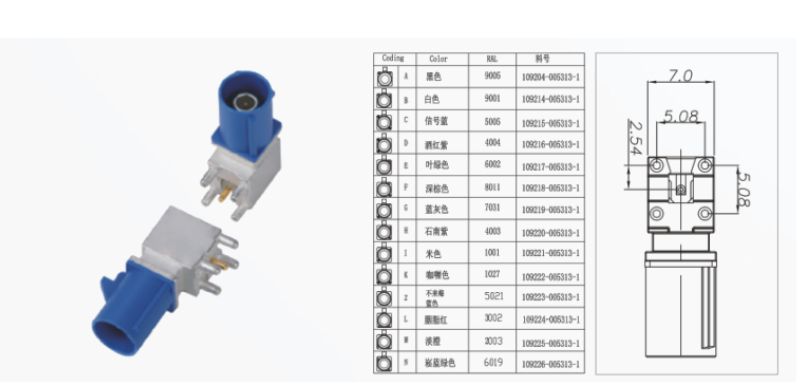
The FAKRA Right-angle Receptacle pairs a 90-degree body with a shielded 50 ohm path built for automotive RF.
The 90-degree body directs the coaxial cable parallel to the board, which helps designers place the receptacle near module edges and stack components above the RF path. This orientation suits slim telematics and camera control units where vertical clearance is scarce.
A zinc alloy outer conductor, tin plated to 100 µin minimum, surrounds the contact and provides the return path and mechanical ground that RF links need. Copper alloy contacts, also tin plated to 100 µin minimum, carry the center signal and support a controlled 50 ohm interface from DC to 6 GHz.
The HTN housing withstands the 260°C reflow profile and remains stable from −40°C to +105°C, so the receptacle fits under-hood and cabin modules alike. A secondary lock rated at 110 N keeps the housing seated, while terminal retention at 10 N prevents push-back during mating.
Rated for at least 25 insertion cycles with insertion force up to 25 N and extraction force from 2 N, the receptacle gives a consistent, tool-free engage that service teams can repeat without special fixtures.
FAKRA Right-angle Receptacle fits telematics control units that route GNSS and cellular antennas to the module through a short coaxial run, letting that line lie flat against the board so the unit keeps a low profile inside the enclosure. In-vehicle infotainment head units pull broadcast and connectivity signals from roof or shark-fin antennas; placing the FAKRA interface at a board edge with a 90-degree exit simplifies harness routing and keeps the RF path away from noisy power sections. Camera and radar modules at the vehicle perimeter often sit close to the body panel, where a right-angle body helps the coaxial link turn into the PCB without raising the stack height, useful when the module is mounted in a shallow housing. Under-hood sensor clusters and V2X antennas also benefit, because the low body clears heatsinks and bracket hardware that would block a straight connector. Across these uses, the receptacle supports the frequency bands that navigation, connectivity, and driver-assistance systems rely on.
The FAKRA Right-angle Receptacle is rated to 750V rms test voltage against a 60V rms working limit, leaving headroom for transient conditions, and carries up to 1A DC in normal operation. Contact resistance stays at 20 mΩ max and insulation resistance reaches 1000 MΩ min for stable links over the service life.
An HTN housing and tin-plated copper alloy and zinc alloy surfaces let the part pass the 260°C reflow profile and operate from −40°C to +105°C, covering both cabin and under-hood modules without a separate variant.
A secondary lock rated at 110 N and terminal retention of 10 N keep contacts seated through vibration, and the 25-cycle mating rating with 25 N max insertion and 2 N min extraction gives service teams a consistent, tool-free engage.
A controlled 50 ohm interface from DC to 6 GHz carries GNSS, cellular, and broadcast signals on one receptacle, so designers can standardize the RF inlet across multiple vehicle antenna feeds.
A: A FAKRA Right-angle Receptacle is a 50 ohm RF coaxial connector whose 90-degree body routes the cable parallel to the PCB. It serves automotive antenna and infotainment links where board height is limited.
A: The receptacle provides a 50 ohm interface operating from DC to 6 GHz, covering GNSS, cellular, and broadcast bands on one footprint. The impedance holds across the range, supporting several vehicle antenna feeds without a separate variant.
A: A right-angle receptacle exits the coaxial cable parallel to the board, saving vertical space in shallow modules, while a straight type runs the line perpendicular. The 90-degree body fits dense layouts where stack height is constrained.
A: Right-angle receptacles suit modules with low stack height, edge-mounted RF inlets, or shallow housings near body panels. The parallel cable exit keeps the RF path flat, helping designers place the connector without raising the board profile.


