

 |


5、FPC0.5mm前插式后翻式H=2.0mm
| Current Rating:0.5A | Insulation Resistance:500MΩ/min |
| Voltage Rating:50V | Withstand Voltage:—— |
| Contact Resistance:≤30mΩ | Operating Temperature Range:-40℃~+105℃ |
| Plastic material:Nylon 、PA669T UL94V-0 | Terminal material:Phosphor Bronze |
tape and reel、 tube packaging、Tape and Reel Package
Note For Wafer Connectors, FPC Connectors, FAKRA Connectors, and HSD Connectors, please contact customer service to confirm the final packaging method based on product specifications, size, and quantity requirements.
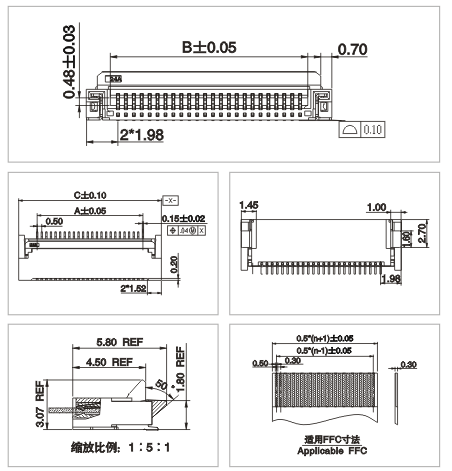
• Front-Insertion Rear-Flip Locking — The FPC inserts from the front while the actuator engages from behind, creating a positive mechanical lock that actually tightens under vibration rather than loosening over time. Benefit: eliminates intermittent signal faults that are notoriously difficult to diagnose in traditional front-flip designs installed within high-shock industrial equipment.
• Low 2.0mm Profile Height — At just 2.0mm above the PCB surface, this connector fits within tight enclosure constraints while maintaining full compatibility with lead-free reflow soldering processes used in high-volume production. Benefit: simplifies thermal management and airflow design in sealed electronic assemblies.
• High-Temperature LCP Insulator — The Liquid Crystal Polymer housing withstands peak reflow temperatures up to 260°C without measurable deformation, ensuring consistent contact positioning and long-term reliability in thermally cycling environments.
Inquire about customized parameters including pin count, tape-and-reel packaging options, and application-specific contact plating requirements.
In industrial automation settings, PLC control boards and distributed sensor interface modules are routinely exposed to mechanical vibration from adjacent machinery, thermal cycling during production shifts, and occasional dust ingress within control cabinets. Standard front-flip FPC connectors can loosen incrementally under sustained vibration, producing intermittent signal faults that are notoriously difficult to diagnose and significantly increase maintenance labor costs.
The JKJ Front-Insertion Rear-Flip connector addresses this failure mode with its unique locking geometry: the rear-mounted actuator grips the FPC progressively tighter as vibration increases, creating a self-stabilizing connection. Its 2.0mm low profile preserves airflow within sealed enclosures, preventing localized hot spots near the connector body.
For automotive electronics including infotainment display modules, dashboard control panels, and EV battery monitoring units, the same rear-flip mechanism ensures FPC connections remain secure across the vehicles entire service life, including thermal excursions from -25°C cold starts to +85°C under-hood operation. The LCP insulator maintains dimensional stability throughout these extremes. Discuss your application needs with our engineering team.
24-Hour Technical Response — Our engineering team provides same-day responses to technical inquiries and delivers application-specific connector recommendations within one business day, accelerating your design review cycle.
Rapid Sample Turnaround — Prototype samples for standard configurations ship within 5-7 business days, with custom pin-count options typically requiring 10-12 business days for completion and first-article approval.
Comprehensive Certification — Both ISO 9001 and IATF 16949 certified production lines ensure rigorous process control, from incoming material inspection through final electrical testing and packaging verification.
Proven Automotive Track Record — Our connectors are deployed across multiple automotive OEM platforms with full PPAP Level 3 documentation, including DFMEA and control plans.
Contact our support team for detailed compliance documentation and vibration test data.
A: Standard samples are produced within 5-7 business days. Custom pin-count or contact plating options may require 10-12 business days for first-article approval.
A: Yes. The rear-flip locking design provides superior vibration resistance compared to conventional front-flip types. We recommend reviewing our in-house vibration test data with your engineering team.


![[GT17HNS2-4DS-2C(A-D)] GT17 Wire End Terminal](http://iororwxhimpllk5p-static.micyjz.com/cloud/liBpkKlmliSRoljpkkplkp/56-GT17HNS2-4DS-2C-A-D-640-640.png "[GT17HNS2-4DS-2C(A-D)] GT17 Wire End Terminal")


