

 |


101039-***311-1
| Current Rating:0.5A | Insulation Resistance:500 MΩ min |
| Voltage Rating:50V | Withstand Voltage:200V AC/min |
| Contact Resistance:≤40mΩ | Operating Temperature Range:-40℃~+120℃ |
| Plastic material:LCP UL94V-0 | Terminal material:CuSn |
tape and reel、 tube packaging、Tape and Reel Package
Note For Wafer Connectors, FPC Connectors, FAKRA Connectors, and HSD Connectors, please contact customer service to confirm the final packaging method based on product specifications, size, and quantity requirements.
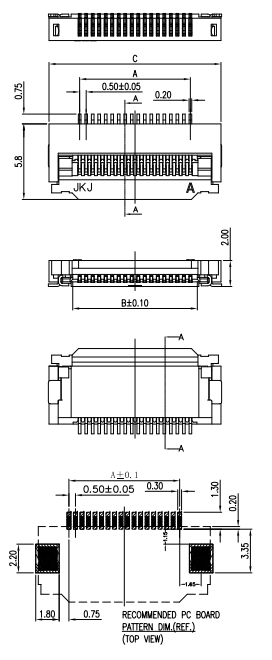
FPC 0.5mm Pitch 2.0H Flip-lock Gold-plated — build details that matter in practice:
Flip-Lock Lid — The lid hinges open to free the contact gap, the FPC seats with near-zero insertion force, and closing the lid clamps the flex so it will not walk out under vibration.
Two-Piece LCP Body — A natural-color housing and a black cover are both molded from LCP rated UL94V-0; the material stays dimensionally stable through the soldering profile.
Gold-Flash Over Nickel — CuSn terminals carry a 50 microinch nickel underplate with a 1 microinch gold flash on the contact and solder areas, giving corrosion resistance without a thick gold build.
Tin-Finished Solder Tab — A CuSn tab with nickel underplate and 100 microinch tin supports mechanical anchoring and a stable ground path at the board.
Electrical Limits — Rated 50V AC/DC at 0.5A per contact, with 40 milliohm max contact resistance, 200V AC withstanding, and 500 megohm min insulation.
FPC 0.5mm Pitch 2.0H Flip-lock Gold-plated fits where a thin flex must stay reachable after assembly:
Wearable and Foldable Devices — A 0.5mm pitch lets the flex hinge route through a tight hinge area, and the flip lid means a technician can open the joint to replace the cable rather than scrap the board.
Outdoor and Automotive Modules — The -40 to 120°C window and UL94V-0 LCP let the socket sit in enclosures that see sun, cold, and under-hood heat without a separate high-temp variant.
Field-Serviceable Instruments — Test and medical handhelds benefit when the flip-lock can be reopened for cable swaps during calibration or repair, cutting downtime versus glued or drawer types.
FPC 0.5mm Pitch 2.0H Flip-lock Gold-plated — why teams specify it:
Flame-Class Moldings — Both the natural housing and the black lid meet UL94V-0, so the part clears the flame-spread requirement common in consumer and automotive intake checks.
Plating Built for Reuse — The gold flash over nickel keeps the contact surface from oxidizing through storage and many mating cycles, which protects field reliability without a costly full-gold finish.
Stable Through Reflow — LCP holds its form and the lid geometry stays aligned during the soldering profile, so placement yield does not depend on a post-reflow adjustment.
Documented Plating Stack — CuSn terminals with specified nickel and gold or tin finishes give a plating system that purchasing can qualify against a drawing rather than a sample.
Q: How should the flip-lock be actuated during assembly?
A: Lift the black lid to open the contact gap, lay the FPC in with the pads facing the upper contacts, then press the lid shut. The lid clamps the flex with light force and no insertion pressure on the cable.
Q: What electrical and temperature ratings does this connector carry?
A: The FPC 0.5mm Pitch 2.0H Flip-lock Gold-plated is rated 50V AC/DC at 0.5A per contact, with 40 milliohm max contact resistance, 200V AC withstanding voltage, 500 megohm min insulation resistance, and an operating range of -40 to 120°C.
Q: Can a 1-micron gold flash really protect the contact?
A: Yes. The 1 microinch gold sits over a 50 microinch nickel underplate that blocks base-metal migration, so the contact face stays solderable and low-resistance through storage and repeated mating.
Q: What makes the flip-lock practical for field service?
A: The lid reopens by hand, so a technician can swap or reseat the FPC during repair or calibration without desoldering the socket. That shortens downtime on handheld and instrument builds.


